



 Achy Muscles
 Arthrite, bursite et tendinite
 Mal de dos
 Fibromyalgie
 Douleur au pied et au bas de la jambe
 Joint Pain
 Knee Pain
 Douleur au cou

If you're spending eight+ hours a day at a desk, you've probably seen ads featuring sleek devices tucked under desks, promising you can exercise while you work, combat the health risks of sitting, and burn calories without leaving your chair.
The appeal is undeniable. Prolonged sitting has documented health consequences, from reduced circulation to increased disease risk (Yale Medicine). The promise that you can counteract these effects while answering emails sounds too good to be true.
So the question becomes: Do under-desk leg exercisers actually work, or are they expensive gadgets destined to collect dust under your desk?
The honest answer is nuanced: Yes, they work for adding movement to otherwise sedentary time. They provide legitimate, measurable benefits, but they can't replace comprehensive exercise, and for some people researching these devices, a completely different type of leg exerciser might better address their actual needs.
What under-desk leg exercisers actually do
Under-desk leg exercisers encompass several types of compact devices designed to fit beneath a standard desk: mini under-desk elliptical machines, under-desk treadmills, pedal exercisers, and under-desk bikes. Despite design variations, they all operate on the same basic principle: You actively pedal or push against adjustable resistance while remaining seated at your workspace.

Unlike passive motion devices that move your legs for you, these are active exercise tools. Your leg muscles contract to generate the movement, your heart rate may increase depending on intensity, and you burn calories based on how hard and how long you work.
Research and practical experience reveal several legitimate advantages to under-desk leg exercisers:
-
They add movement to otherwise completely sedentary time. If you're truly desk-bound for extended periods with limited opportunities for breaks, an under-desk exerciser provides movement that's genuinely better than sitting motionless for eight+ hours. Any movement is preferable to complete stillness when it comes to combating the physiological effects of prolonged sitting.
-
They're lower impact than walking. Research shows that elliptical-style movement places less stress on joints like knees and hips compared to the impact forces of walking (Gait Posture). For someone with arthritis or recovering from certain injuries, this reduced joint loading can make movement more comfortable than weight-bearing exercise. Adjustable resistance levels mean you can tailor the device to meet your needs.
-
They burn calories. While not dramatic, under-desk exercisers do increase energy expenditure. A 155-pound person using an under-desk pedaler burns approximately 258 calories per hour depending on intensity—not insignificant when accumulated over weeks and months, though notably less than walking at 3 mph which burns roughly 304 calories per hour. (SwimRight Academy)
-
They help counteract some circulatory effects of sitting. Prolonged sitting decreases arterial blood flow in lower leg arteries, impairs endothelial function, and leads to fluid retention in the lower limbs. Active pedaling creates muscle contractions that support the muscle pump mechanism, helping maintain better circulation than remaining completely still.
-
They're convenient. For desk workers with genuinely limited flexibility in their schedules, having an exercise option that doesn't require leaving your workspace removes a significant barrier to movement.
However, these benefits come with an important caveat: User compliance varies dramatically. Initial enthusiasm tends to be high, with frequent use in the first weeks after purchase. But novelty often wears off, and many devices see sharply declining use after the first month or two.
The device that seemed like a brilliant solution on day one becomes an expensive, guilt-inducing footrest by month three for a substantial percentage of users. This pattern matters when evaluating whether under-desk exercisers "work." A device that works wonderfully in theory but sits unused works not at all in practice.
What under-desk exercisers can't deliver
If your expectations don't match reality, you'll either be disappointed with results or worse—you'll use the device as justification to skip the movement your body actually needs.
-
They can't replace comprehensive exercise. While under-desk exercisers provide some cardiovascular stimulus, they don't deliver the functional movement patterns, balance training, or full range of motion that walking and other standing exercises provide. You're not training the stability and coordination that prevent falls. You're not developing the postural control needed for real-world movement. The fixed, seated position eliminates many of the functional benefits that make exercise valuable beyond simple calorie burn.
-
They don't provide weight-bearing stimulus. Your bones need loading to maintain or increase density. Seated pedaling doesn't provide this. There's no gravitational stress encouraging your skeletal system to stay strong, which matters enormously for long-term bone health and fracture prevention, particularly as you age.
-
The multitasking promise often fails. This is perhaps the most oversold aspect of under-desk exercisers. The marketing suggests you can work at full capacity while exercising effectively—getting two activities done simultaneously. Reality is messier. Many users find that either their work quality suffers (reduced focus and accuracy on complex tasks) or their exercise intensity drops (slow, distracted pedaling that provides minimal benefit).
-
You can't give 100% to both simultaneously. Simple tasks like reading emails or making phone calls might work fine while pedaling, but focused analytical work typically demands your full attention. The result is that many people either pedal very lightly while working (minimal fitness benefit) or stop pedaling when real work demands kick in.
-
Intensity ceiling is low. It's difficult to achieve truly vigorous exercise intensity while seated at a desk trying to maintain work posture. The positioning and stability requirements limit how hard you can push. This means you're generally stuck in the mild-to-moderate intensity range, which provides benefits but falls short of what higher-intensity exercise delivers for cardiovascular health and metabolic improvements.
-
The novelty factor is real. For many users, initial excitement about the device leads to frequent use in the first weeks. But as the novelty wears off and the device becomes part of the furniture, usage drops dramatically. The motivation that came from newness disappears, and without a genuine commitment to using the device consistently, it stops being an effective tool regardless of its theoretical benefits.
-
They might support weight loss, but they probably won't drive it. If you're trying to lose weight, focus on walking if you're able, combined with appropriate nutrition changes, rather than relying primarily on an under-desk exerciser. View under-desk exercise as a supplement that reduces sedentary time, not as your primary weight loss tool.
When under-desk exercisers genuinely make sense
Despite these limitations, under-desk leg exercisers do serve legitimate purposes in specific situations:
-
Truly unavoidable extended desk time
-
As part of a broader movement routine that includes regular walking, standing, and other forms of exercise
-
During certain injury recoveries where you've been cleared for seated pedaling but not yet for walking or weight-bearing exercise (always with medical guidance)
-
When weather or circumstances temporarily prevent outdoor walking and you have no access to treadmills or indoor walking spaces
The key phrase is "supplement to" rather than "replacement for" more comprehensive movement.
The most effective strategy isn't choosing between walking and under-desk exercise—it's using both appropriately:
-
Walking as your primary movement activity: Before work, during breaks, after work, for transportation and errands
-
Under-desk exerciser during truly unavoidable sitting: Long conference calls, email processing, reading tasks that don't demand intense focus
This combination reduces sedentary time while preserving the irreplaceable benefits of actual walking.
The walking comparison: Why it remains superior
We've covered walking extensively in our article comparing leg exercisers to walking, but it's worth briefly revisiting why walking remains the better option when you're capable of it.
Walking provides benefits that seated exercise simply cannot match:
-
Cardiovascular conditioning that raises your heart rate meaningfully
-
Functional strength that translates directly to daily activities
-
Balance and coordination training that prevents falls
-
Weight-bearing stimulus for bone density
-
Full range of motion through the hips and ankles
-
Mental health benefits from changing your environment and getting away from your workspace
Walking is also free, infinitely scalable in intensity, socially engaging when done with others, and integrates seamlessly into daily life through transportation, errands, or lunch breaks.
Passive devices: Why some need a completely different approach
Here's something most articles about under-desk exercisers won't tell you: A significant number of people researching these devices are actually looking for a solution to a completely different problem: They're dealing with mobility challenges that make traditional exercise difficult or impossible, such as
-
Arthritis that makes active pedaling painful
-
Balance issues or fall risk that make standing exercise feel dangerous
-
Recovery from surgery, stroke, or injury where active exercise isn't yet cleared
-
Neurological conditions affecting coordination or muscle control
-
Advanced age where sustained active exercise has become too challenging
If you recognize yourself in this list, an active under-desk exerciser probably isn't what you need. Devices that require you to generate movement through muscular effort won't serve you well if effort itself is the barrier.
The passive motion alternative
For people who cannot perform active exercise safely or comfortably, passive motion devices address entirely different needs through fundamentally different mechanisms.
Passive leg exercisers move your legs for you through continuous passive motion. You remain comfortably seated while the device gently moves your feet and legs through a predetermined range of motion. There's zero muscular effort required: Your muscles don't contract to generate movement, your heart rate doesn't increase, and you're not burning significant calories.This isn't a design limitation. It's the entire point.
Passive motion devices aren't exercise equipment. They're designed to support circulation and maintain joint mobility for people who cannot perform active exercise. They address the physiological consequences of immobility rather than providing fitness benefits.
What passive motion provides:
-
Circulation support when active movement isn't possible. When you sit for extended periods unable to move, blood flow in your lower legs decreases, leading to swelling, discomfort, and increased health risks. Passive motion provides gentle, continuous movement that supports the muscle pump mechanism, helping counteract circulatory stagnation when active muscle contraction isn't possible.
-
Joint mobility maintenance without weight-bearing stress. Your joints depend on movement to stay lubricated and healthy. Research shows that cyclical joint movement significantly increases production of synovial fluid—the substance that lubricates cartilage and reduces friction (J Funct Morphol Kinesiol.). For someone with severe arthritis who finds active movement too painful, or someone recovering from surgery who isn't cleared for exercise, passive motion provides gentle joint articulation that supports lubrication without requiring weight-bearing, balance, or pushing through pain.
-
Safe, seated movement for those with balance concerns. Perhaps most importantly, passive motion devices eliminate fall risk entirely. You remain safely seated in a comfortable chair with no concern about losing balance, your knees giving out, or any of the dangers that make standing exercise feel unsafe for those with balance disorders, vertigo, or significant mobility limitations.
The DR-HO'S MotionCiser approach
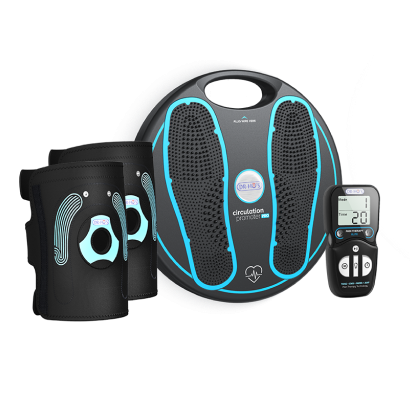
The DR-HO'S MotionCiser is a passive motion device that integrates three complementary technologies:
-
Continuous passive motion moves your feet and legs through walking-like patterns while you remain comfortably seated.
-
High-frequency vibrational massage adds muscular stimulation that complements the passive motion. The vibrations help stimulate the muscles to assist with the stiffness that many people with limited mobility experience.
-
Therapeutic heating with five adjustable temperature settings addresses a common concern for people with circulation issues—cold feet. The gentle warmth helps relax muscles, supports tissue flexibility, and supports local blood flow. Many users find the combination of movement and heat particularly soothing for extended use.
This integrated approach addresses joint mobility, circulation support, muscle stimulation, and comfort simultaneously—providing comprehensive support for those whose mobility limitations prevent active exercise.
How to know which type of device you actually need
Ask yourself these questions:
-
Can you actively pedal or push against resistance for 20+ minutes? If yes, an active under-desk exerciser might work for you (though walking remains superior when possible). If no, active exercisers will frustrate you because they require the very capability you don't have.
-
Is pain, balance, or mobility preventing you from performing active exercise? If yes, passive motion devices address your actual needs—circulation support and joint mobility when movement isn't possible. Active exercisers won't help because they require active effort.
-
Are you capable of walking? If yes, that should be your primary focus for leg health and overall fitness. Both active and passive leg exercisers should be viewed as supplements or supports, not replacements for walking's comprehensive benefits.
Being honest about which category describes your situation helps you invest in the right solution rather than buying a device that doesn't match your actual needs.
Disclaimer: DR-HO'S content is intended for informational purposes only and should not be taken as medical advice. Please consult a certified medical professional for diagnosis and treatment recommendations. If you have any pre-existing health conditions, consult your healthcare practitioner before implementing any new exercise regimen.

MotionCiser V2 - Appareil d'exercice passif chauffant pour les jambes - Pack essentiel
$259.99 CAD
FAQs
Can you really work effectively while using an under-desk exerciser?
It depends on the task and your ability to split attention. Simple activities like reading emails, making phone calls, or reviewing documents may work fine while pedaling. However, complex focused work requiring analytical thinking, problem-solving, or detailed attention often suffers when you try to multitask. Many users find they either reduce work quality or exercise intensity when attempting both simultaneously. Consider using the exerciser during scheduled breaks or simple tasks rather than during work requiring your full cognitive capacity.
How long should I use an under-desk leg exerciser?
Start with 10-15 minute sessions and gradually increase based on comfort and tolerance. Many people use them intermittently throughout the day rather than continuously—perhaps 20 minutes in the morning, 20 minutes after lunch, and 20 minutes in the afternoon. Most importantly, don't let under-desk exercise time replace walking breaks you could otherwise take. The goal is adding movement to otherwise sedentary hours, not substituting seated pedaling for standing and walking.
Are under-desk exercisers good for seniors?
It depends entirely on the senior's capabilities and needs. Seniors who can actively pedal and maintain seated stability might benefit from under-desk exercisers as supplements to walking. However, seniors with significant mobility limitations, severe arthritis, balance concerns, or conditions that make active effort difficult may benefit more from passive motion devices like the DR-HO'S MotionCiser that provide circulation and joint mobility support without requiring active muscle contraction. The key is matching the device type to actual capabilities rather than aspirations. See our complete guide on passive leg exercisers for seniors for detailed guidance.